
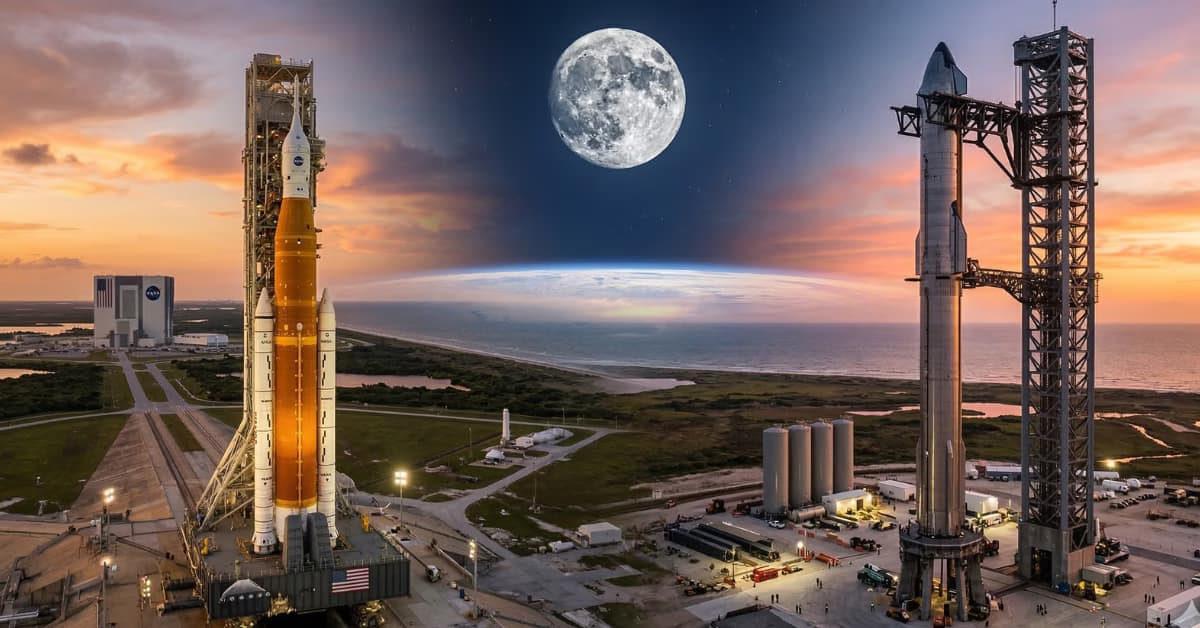
The aerospace industry is moving at breakneck speed this season. From massive government defense contracts to highly anticipated lunar missions, there is a lot of ground to cover. Here is your comprehensive guide to the latest global rocket launches, technological upgrades, and mission approvals.
NASA’s Artemis II Ready for the Moon
NASA officials have officially given the green light for the Artemis II mission. Confident in the spacecraft’s readiness, the agency is skipping an additional fueling test on the Space Launch System (SLS) rocket. The massive launch vehicle will roll out to the pad next week, targeting a liftoff on April 1 at 6:24 pm EDT. If the April 1 window is missed, NASA has a few backup dates through April 6 before lunar alignment forces a month-long delay. The nine-day mission will carry four astronauts around the Moon and return them safely to a Pacific Ocean splashdown.
Firefly and Rocket Lab Execute Successful Missions
Firefly Aerospace successfully launched its Alpha rocket from Vandenberg Space Force Base, marking a triumphant return to flight after a 10-month hiatus. This specific mission validated vital upgrades for the upcoming Block II rocket configuration, which will feature a longer frame, enhanced thermal protection, and stronger carbon composite structures.
Meanwhile, Rocket Lab executed its 83rd Electron flight from New Zealand, delivering a payload to low-Earth orbit for a confidential client. Industry insiders strongly suspect the customer is the remote sensing company BlackSky, which recently announced the activation of a new optical Earth-imaging satellite just days after the launch.
Pentagon Ramps Up Missile Defenses
Shifting to national defense, the Pentagon has finalized a $1.36 billion agreement with RTX (formerly Raytheon) to significantly increase the production of missile interceptors. The Missile Defense Agency ordered 23 additional SM-3 Block IB missiles, bringing the total order to 78. This push is part of a broader military effort to replenish weapons inventories amidst ongoing global conflicts.
Commercial Satellites and International Launches
SpaceX recently completed its 30th Falcon 9 flight of the year, delivering the EchoStar XXV direct television satellite into geosynchronous Earth orbit. This marks a relatively rare event, as the industry has largely shifted its focus toward low-Earth orbit mega-constellations like Starlink, making large commercial geostationary launches much less common today.
Internationally, China has resumed its orbital launch cadence following a pause during the Lunar New Year. Two Long March rockets successfully deployed a batch of internet satellites and classified military payloads, continuing the country’s rapid expansion of its orbital networks.
SLS Upper Stage Cancelled and Starbase Pad 2 Activates
In a significant shift for NASA’s heavy-lift capabilities, the agency has officially canceled the Boeing-led Exploration Upper Stage for the SLS rocket. Instead, NASA will acquire next-generation upper stages from United Launch Alliance (ULA) for the Artemis IV and V missions, opting for a more affordable commercial alternative.
Finally, at SpaceX’s Starbase facility in Texas, the company has officially activated its second launch pad. A new Block 3 Super Heavy booster is currently mounted on Pad 2 for commissioning. While a static fire test isn’t immediately planned, SpaceX is heavily targeting an early April test flight for the upgraded Starship system.
Next Three Launches on the Calendar
- March 13: Falcon 9 | Starlink 17-31 | Vandenberg Space Force Base, CA
- March 14: Falcon 9 | Starlink 10-48 | Cape Canaveral Space Force Station, FL
- March 15: Long March 6A | Unknown Payload | Taiyuan Satellite Launch Center, China