Many businesses are eager to implement artificial intelligence, but getting started can often feel overwhelming and complicated. Building AI projects requires much more than just hiring a few engineers; it demands a clear understanding of practical workflows, proper project selection, and effective cross-departmental teamwork. By breaking down the concepts taught by platforms like deeplearning.ai and experts like Andrew Ng, you can confidently launch an AI initiative in your own organization.
Understanding Workflows: Data Science vs. Machine Learning
A crucial first step is understanding that machine learning (ML) and data science (DS) have distinctly different workflows and use cases.
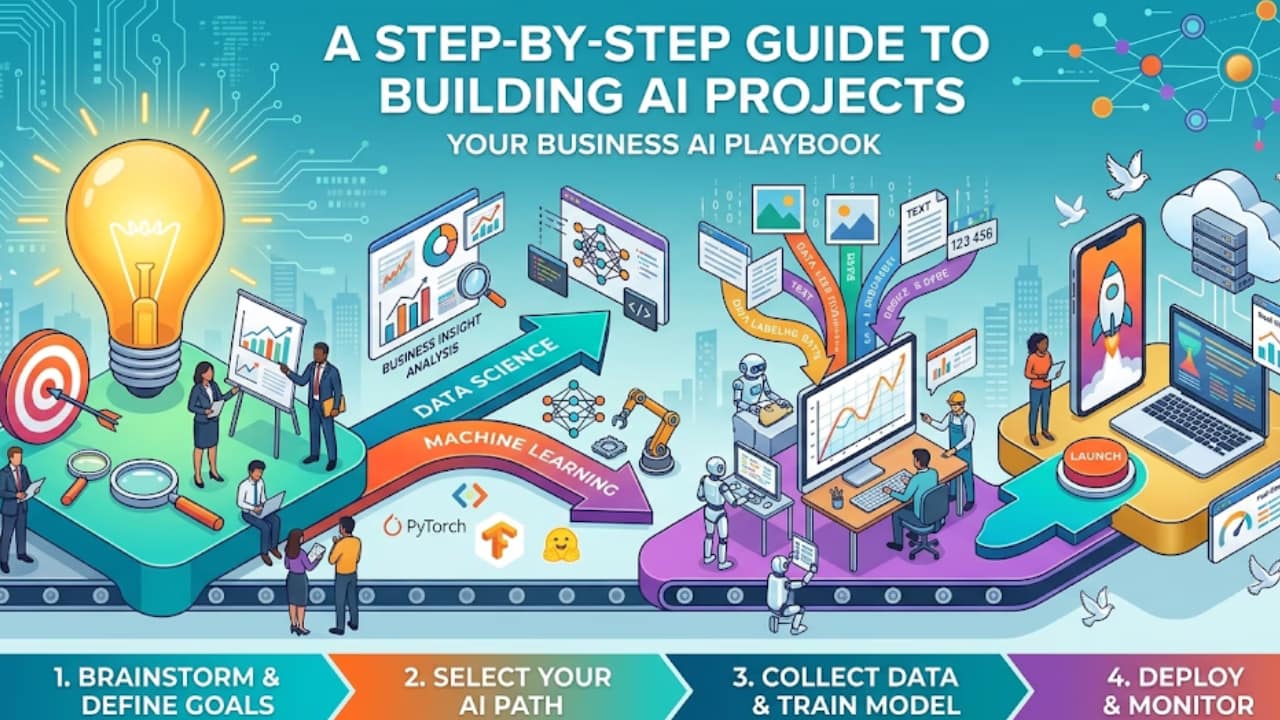
The Machine Learning Workflow When building a system like speech recognition (think Amazon Echo/Alexa or Google Home) or the vision systems for a self-driving car, the process follows a specific cycle.
- First, you must collect data, such as capturing images or mapping the positions of other cars on the road .
- Second, you train the model, iterating many times until the software is good enough to perform the task.
- Third, you deploy the model into the real world, get data back from its performance, and continuously maintain and update the model over time .
The Data Science Workflow If your goal is optimizing a sales funnel for an e-commerce website (tracking user behavior from the product page to the shopping cart to checkout) or improving efficiency on a manufacturing line, you need a data science approach . The steps here involve:
- Collecting data from your operations.
- Analyzing that data and iterating to find good insights.
- Suggesting hypotheses or actionable business actions.
- Deploying changes to the business process.
- Re-analyzing new data periodically to see if the changes worked.
To put this into perspective, in the agricultural sector, data science provides crop analytics, while machine learning powers precision weed-killing robots . In a corporate recruiting department, data science analyzes the email outreach and interview funnel, whereas machine learning is used to build automated resume screening software . Every job function needs to learn how to use data effectively.
How to Choose the Right AI Project
Selecting the right project requires combining two entirely different areas of knowledge. You need domain experts who truly understand “things valuable for your business,” working alongside AI experts who know exactly “what AI can do” .
A great brainstorming framework is to think about optimizing specific tasks rather than trying to automate entire jobs. For example, focus on automating call center routing or specific analytical duties of radiologists, rather than trying to replace the workers entirely. Ask yourself what the main drivers of business value are, and pinpoint the main pain points in your business. Also, keep in mind that while having more data makes some businesses defensible and almost never hurts, you can still make significant progress even with small datasets .
Conducting Due Diligence
Before dedicating resources, you must perform proper due diligence on the project.
- Technical Diligence: Ask if the AI system can actually meet the desired performance. Determine exactly how much data is needed and map out a realistic engineering timeline.
- Business Diligence: Ensure the project will lower costs or increase revenue for your current business, or help you launch a completely new product or business line .
When deciding whether to build the solution yourself or buy an existing one, remember that ML projects can be developed in-house or outsourced, but data science projects are more commonly kept in-house . Crucially, avoid wasting time building things that are considered an industry standard; buy those instead.
Working Successfully with Your AI Team
Clear communication is mandatory when working with an AI team. You need to clearly specify your acceptance criteria right from the start. For instance, if you are visually inspecting coffee mugs on a manufacturing line for cracks, your goal might be to detect defects with exactly 95% accuracy . You must provide the AI team with a dataset on which to measure their performance against this goal.
AI teams categorize data strictly into a “training set” used to teach the AI, and a separate “test set” used to evaluate it. One major pitfall for business leaders is expecting 100% accuracy. Machine learning has very real limitations, and frustrating errors can occur due to insufficient data, mislabeled data, or ambiguous labels .
The Technical Tools of the Trade
Finally, AI teams rely heavily on a specific technical ecosystem. For machine learning frameworks, open-source tools like PyTorch, TensorFlow, Hugging Face, Paddle Paddle, Scikit-learn, and R are the industry standards . Teams also stay updated by leveraging open-source code repositories on GitHub and reading the latest research publications on Arxiv. Hardware is equally important; technical teams must choose between standard Central Processing Units (CPUs) and highly powerful Graphics Processing Units (GPUs) to handle the workload, as well as decide whether to run the software in the cloud or strictly on-premises.