Artificial intelligence is no longer just a concept from science fiction; it is rapidly becoming the driving force behind modern business and technology. According to research by McKinsey, AI is expected to generate between $13 trillion and $22 trillion in value creation by the year 2033. A significant portion of this growth—roughly $3 trillion to $4 trillion—will come specifically from generative AI technologies.
This massive economic impact will be felt across almost every major industry . For example, AI is projected to add $0.8 trillion in value to the retail sector , $480 billion to travel , and $475 billion to transport and logistics. With numbers this large, understanding the basics of AI, as taught by platforms like deeplearning.ai and experts like Andrew Ng, is essential for everyone.
Understanding the Different Types of AI
When demystifying AI, it is helpful to divide it into distinct categories:
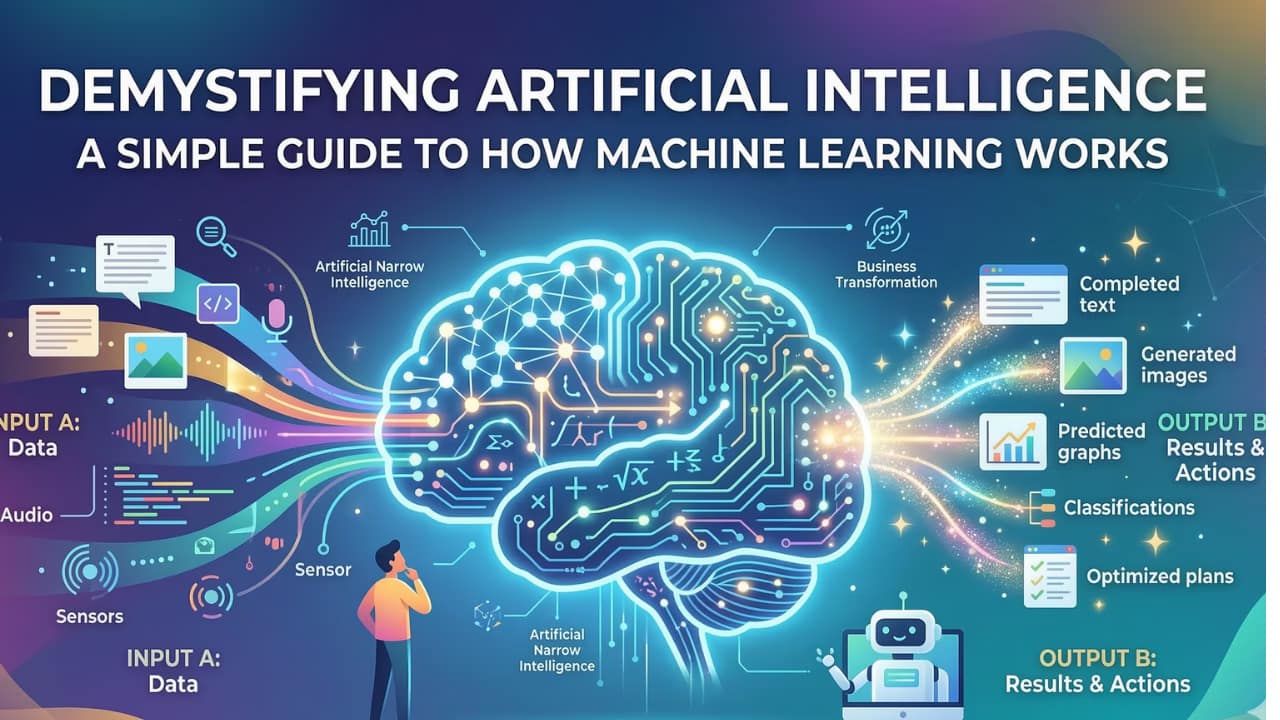
- ANI (Artificial Narrow Intelligence): This is the AI we interact with daily. It is specialized to perform specific tasks, such as powering smart speakers, guiding self-driving cars, filtering web searches, and optimizing processes in farming and factories.
- Generative AI: This branch focuses on creating new content. Popular examples of generative artificial intelligence include large language models like ChatGPT and Bard, as well as image generators like Midjourney and DALL-E.
- AGI (Artificial General Intelligence): This is the theoretical future of AI. An AGI system would be able to do anything a human being can do, though we are not there yet.
Machine Learning vs. Data Science
People often use technical buzzwords interchangeably, but there are important distinctions between them.
In 1959, Arthur Samuel defined machine learning as a “field of study that gives computers the ability to learn without being explicitly programmed”. Data science, on the other hand, is the science of extracting meaningful knowledge and actionable insights from data.
At the core of modern machine learning is “Supervised Learning”. This process is actually quite straightforward: you give the computer an Input (A), and it learns to produce a specific Output (B).
- In spam filtering, an email (Input) is analyzed to predict if it is spam or not (Output: 0 or 1).
- In speech recognition, an English audio clip (Input) is converted into text transcripts (Output).
- In visual inspection, an image of a phone (Input) is checked to predict if there is a manufacturing defect (Output: 0 or 1).
This supervised learning concept is exactly how Large Language Models (LLMs) function. LLMs are built by repeatedly predicting the next word in a sequence of words. When a massive AI system is trained on a dataset containing hundreds of billions of words, the result is a highly capable chatbot like ChatGPT.
The Role of Data and Deep Learning
Data is the crucial fuel that powers AI. However, data can be messy, and the rule of “garbage in, garbage out” always applies. Datasets can suffer from problems like incorrect labels or missing values, which will directly harm the AI’s performance.
To process this data, engineers often use Deep Learning and (Artificial) Neural Networks. While these neural networks were originally inspired by the human brain, the reality is that they are essentially just big mathematical equations. The details of how these mathematical networks operate are almost completely unrelated to how biological brains actually work.
What Makes a True AI Company?
Just because a business uses a neural network does not mean it is an “AI company”. During the internet era, simply having a website did not make a traditional shopping mall a true internet company.
To survive in the AI era, a company needs specialized traits:
- Strategic data acquisition and a unified data warehouse.
- Pervasive automation across its operations.
- New roles, such as Machine Learning Engineers (MLE), and a modern division of labor.
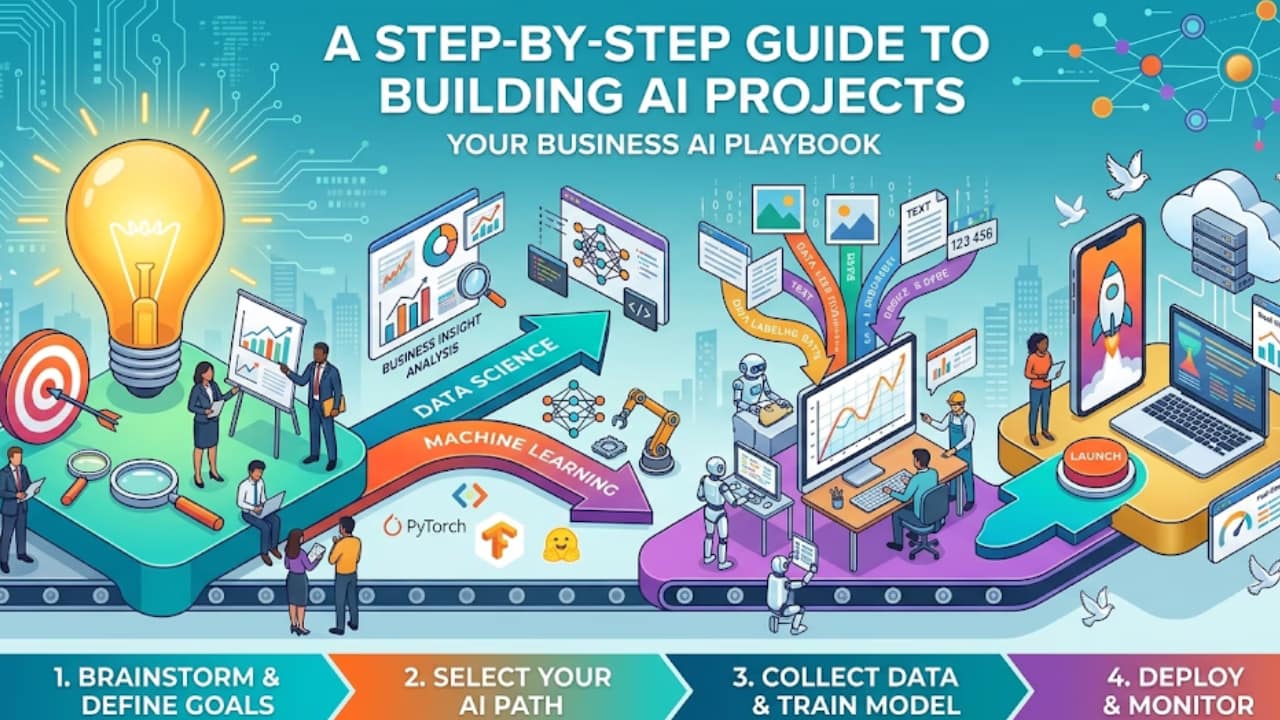
Transforming into an AI company is a multi-step process. It starts with executing pilot projects to build momentum, followed by building an in-house AI team and providing broad AI training to staff. Finally, leadership must develop a clear AI strategy and focus on both internal and external communication.
What AI Can and Cannot Do Today
While AI is incredibly powerful, it has clear limitations. A simple rule of thumb for supervised learning is: “Anything you can do with 1 second of thought, we can probably now or soon automate”.
Machine learning excels when it is tasked with learning a “simple” function and has access to lots of data. For example, AI can accurately diagnose pneumonia if it is trained on approximately 10,000 carefully labeled medical images. A self-driving car can easily learn to recognize a stop sign.
However, machine learning performs poorly when asked to learn highly complex functions from very small amounts of data. You cannot teach an AI to diagnose pneumonia by just showing it 10 images from a medical textbook chapter. Similarly, predicting the stock market over time remains an incredibly difficult, unsolved challenge for AI. AI also struggles when it encounters completely new types of data it hasn’t learned from, or when it requires high-accuracy interpretation of complex human behavior, like understanding a bicyclist’s hand signal or a hitchhiker on the side of the road.
Understanding these foundational concepts is the first step toward responsibly building AI projects and integrating machine learning safely into our society.